
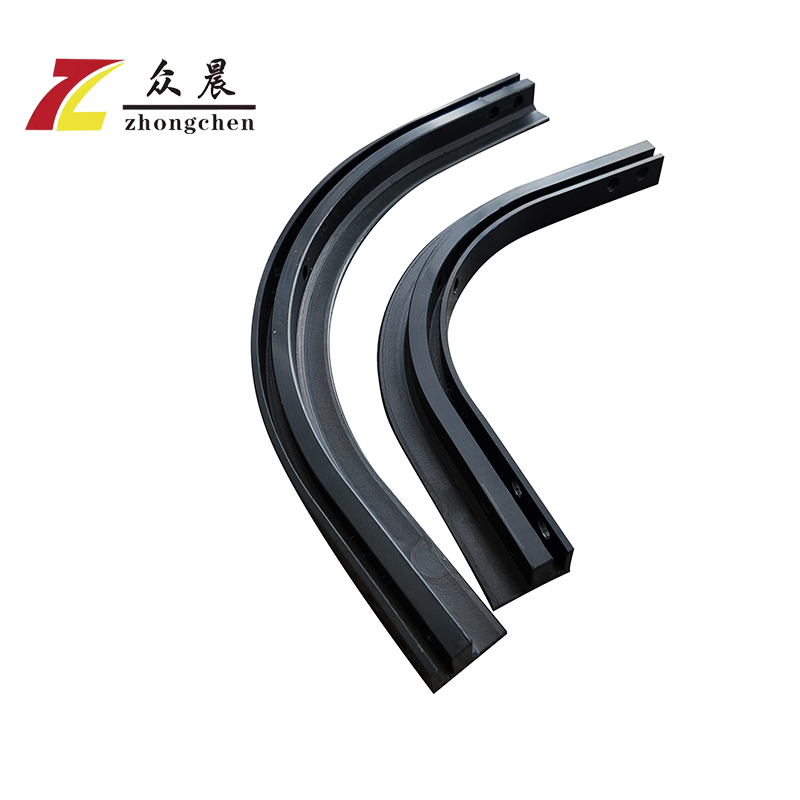
Automated conveyor lines require precise product guidance to maintain stable and efficient material flow. When products move at high speed, direct contact with conventional metal guide components can create friction, noise, scratches, and premature wear.
UHMWPE guide rails provide a durable contact surface that can help improve product handling while protecting both the conveyor system and transported products.
Smooth Product Guidance
UHMWPE has a naturally low coefficient of friction, allowing products to slide along guide surfaces with relatively low resistance. This is particularly useful for conveyor systems where containers, cartons, trays, or other products must remain properly aligned during continuous movement.
A smooth guide surface can help reduce unnecessary drag and support consistent product positioning.
Protecting Products During Conveying
Metal guide rails can sometimes cause scratches, scuffing, or surface damage when products repeatedly contact them. UHMWPE provides a softer contact surface that can reduce the risk of marking sensitive product surfaces.
This makes UHMWPE suitable for applications involving plastic containers, packaged goods, food-processing equipment, and other products where surface appearance matters.
Excellent Wear Resistance
Guide rails experience continuous contact and therefore require materials capable of handling repeated sliding. UHMWPE offers strong abrasion resistance and can maintain its performance under demanding operating conditions.
Longer-lasting guide rails can reduce the frequency of component replacement and help minimize unexpected maintenance interruptions.
Suitable for Automated Production
Modern production facilities increasingly rely on automated conveyor systems operating for extended periods. UHMWPE guide rails can support these systems by providing reliable product guidance without requiring frequent lubrication.
Their low-maintenance characteristics can be particularly valuable in automated manufacturing environments where reducing manual intervention is important.
Easy to Customize
UHMWPE guide rails can be machined into different shapes and profiles to match specific conveyor designs. Manufacturers can produce straight rails, curved sections, mounting holes, slots, and other customized features according to equipment requirements.
This flexibility allows UHMWPE components to be integrated into both new conveyor systems and existing production lines.
Common Applications
UHMWPE guide rails can be used in:
Bottle and container conveyors
Packaging lines
Automated sorting systems
Carton handling equipment
Food and beverage machinery
Pharmaceutical production equipment
Warehouse automation systems
General industrial conveyors
Key Factors When Selecting Guide Rails
When choosing UHMWPE guide rails, engineers should consider product dimensions, conveyor speed, contact pressure, operating temperature, installation method, and expected service conditions.
The correct rail profile and mounting configuration are also important for maintaining stable product guidance and preventing unnecessary movement during operation.
Conclusion
UHMWPE guide rails provide a practical solution for automated conveyor systems that require smooth product movement, reliable guidance, and reduced surface damage. Their combination of low friction, wear resistance, impact tolerance, and machining flexibility makes them suitable for a wide range of automated material handling applications.
With the right design and installation, UHMWPE guide rails can contribute to more stable conveyor operation and lower long-term maintenance requirements.