
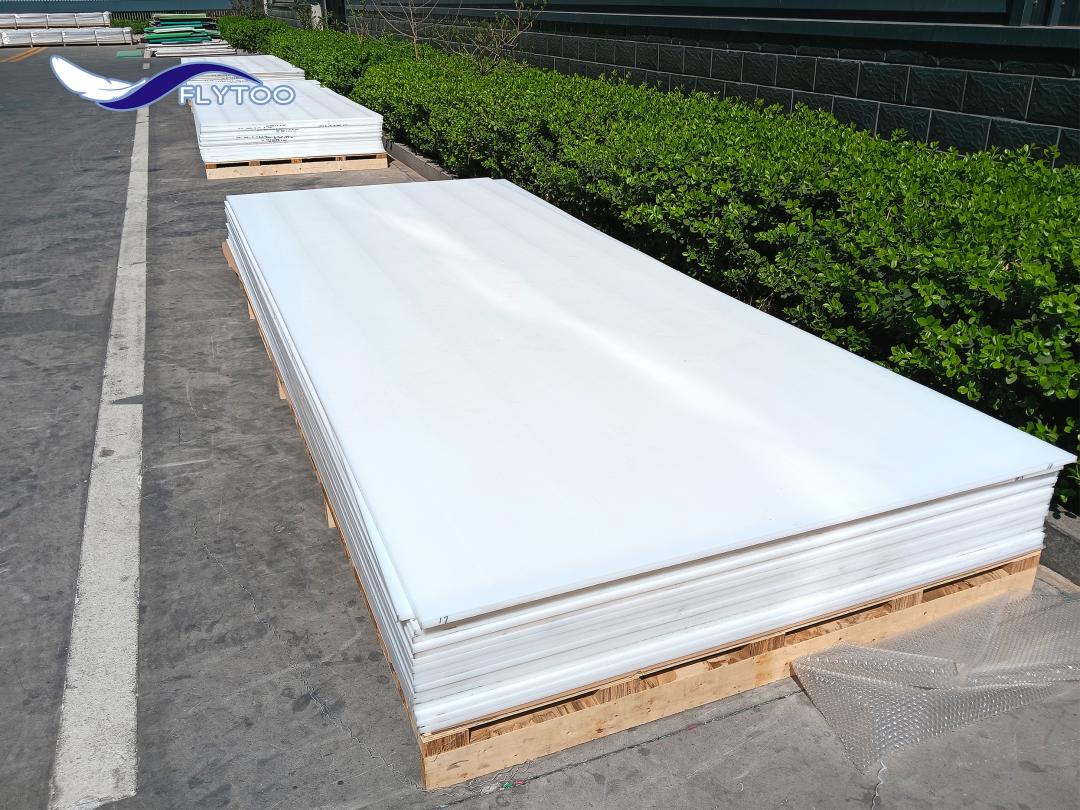
Water exposure is a common challenge in industrial equipment. Materials used outdoors, in marine systems, food processing, mining, and water-related applications may experience continuous contact with moisture.
UHMWPE offers a useful advantage in these environments because of its very low water absorption.
What Is Water Absorption?
Water absorption refers to the amount of moisture a material takes in when exposed to water or humid conditions.
For some plastics, moisture absorption can lead to dimensional changes or changes in mechanical properties. UHMWPE absorbs very little water compared with many other engineering polymers.
Dimensional Stability in Wet Environments
Low moisture absorption helps UHMWPE maintain relatively stable dimensions when exposed to water.
This can be important for components that require consistent clearance or smooth movement, such as wear strips, guide components, bushings, and sliding parts.
Suitable for Wet Industrial Conditions
UHMWPE can be considered for applications involving:
Wet material handling
Marine equipment
Water treatment equipment
Food-processing machinery
Outdoor machinery
Mining equipment exposed to moisture
Bulk material systems
Its resistance to moisture can complement its low friction and wear-resistant characteristics.
Water Exposure Does Not Eliminate Design Considerations
Although UHMWPE has very low water absorption, the complete system still needs to be evaluated. Fasteners, mating components, adhesives, seals, and supporting structures may have different responses to moisture.
Installation design is therefore just as important as material selection.
Conclusion
Low water absorption is one of the useful characteristics of UHMWPE for wet industrial environments. When combined with low friction and strong wear resistance, it makes UHMWPE a practical material option for a wide range of moisture-exposed components.